
Legal status
3 rulebooks for Sermorelin
A former childhood medicine, an ingredient used in pharmacy compounding, a prohibited substance in sport. The answer changes with the question being asked.
Approval, compounding and the rules of sport
The anti-doping laboratory
The Sermorelin paper I least expected to start with concerns detection. Esposito and colleagues reviewed laboratory methods for finding synthetic GHRH analogs in doping control in 2021. A substance that prompts the body to release its own growth hormone still falls within sport's prohibition. The word “natural” offers an athlete very little guidance here.
That is why the name Legal Sermorelin interests me. A medicine can have a genuine approval history, be prepared under a conditional compounding policy, and remain prohibited in competitive sport. Those statements coexist quite comfortably once each has its proper subject. Trouble starts when “legal” becomes a general certificate of merit.
I regard permission as the beginning of the discussion. The next questions concern the medicine, the purpose, the person deciding, and the health outcome actually measured.
I. FDA approval and withdrawal
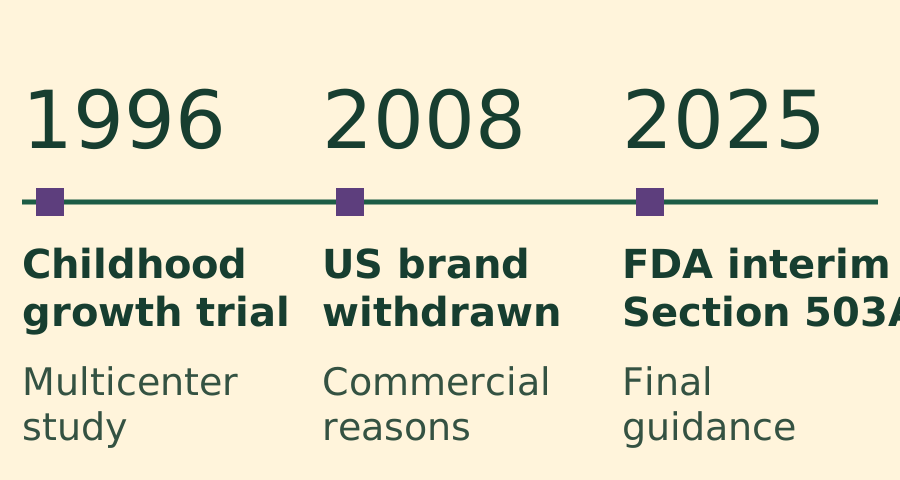
Sermorelin's former approved prescription product had a specific medical setting: diagnosis and treatment of idiopathic growth hormone deficiency in children. The treatment research included children whose first-year height velocity rose from about 4.1 cm/year to roughly 7-8 cm/year. The multicenter growth trial also reported no excessive IGF-1 generation; IGF-1 is the growth-supporting hormone produced largely by the liver in response to growth hormone.
US sales of the branded product ended in 2008 for commercial reasons, rather than a finding of harm or failed effectiveness. A subsequent clinical review described the gap in commercially available GHRH and its consequences for diagnostic testing. That history deserves precise wording. The old approval concerned a defined childhood use; today's adult wellness claims require their own clinical support.
II. Pharmacy compounding
Sermorelin is treated as a long-standing Category 1 bulk drug substance under FDA’s interim Section 503A compounding policy. The final guidance was issued in January 2025. FDA does not intend enforcement action against compounding with Category 1 substances under that policy; the other requirements for prescriptions and preparation still apply.
Sermorelin is not a controlled substance under the Controlled Substances Act, and personal treatment still requires a prescription. Section 503A concerns pharmacy preparation for an individual patient's prescription. Compounded medicines are not FDA-approved. Category 1 describes the ingredient's place in an interim framework, with further review ahead of it. It supplies no finding that adult fat loss, improved sleep or healthier aging has been established.
Of these permissions, the compounding category seems the easiest to inflate. An ingredient's eligibility and a particular preparation's compliance each have conditions, while a benefit still needs evidence from people given the relevant medicine. A laboratory-use label supplies no assurance of suitability for patient treatment.

III. Competitive sport
WADA prohibits growth hormone secretagogues, including GHRH and its analogs. The anti-doping detection review concerns enforcing that rule. A doctor's involvement does not lift the sport ban, and the fact that Sermorelin stimulates endogenous hormone—hormone made inside the body—does not put it outside the prohibited family.
Even away from competition, this separation of authority seems useful to me. A sport prohibition establishes a sporting rule. It cannot settle a pharmacy's obligations or demonstrate an improvement in strength. Conversely, the pharmacy policy cannot settle an athlete's eligibility.
What is Sermorelin?
Sermorelin is a synthetic peptide corresponding to the first 29 amino acids of growth hormone-releasing hormone, or GHRH. It stimulates growth hormone-producing cells in the pituitary gland, beneath the brain. The pituitary supplies the growth hormone; somatostatin and IGF-1 feedback continue to regulate release.
For adult Sermorelin benefits, the striking early finding is higher growth hormone and IGF-1 readings in healthy older men over 14 days. Lasting gains in strength or general health remain unestablished. I respect the hormone finding on its own terms; the much larger aging claim remains unsettled. The research page follows that distinction; fat and muscle gets a separate discussion because so many of the cited adult results involve tesamorelin.